
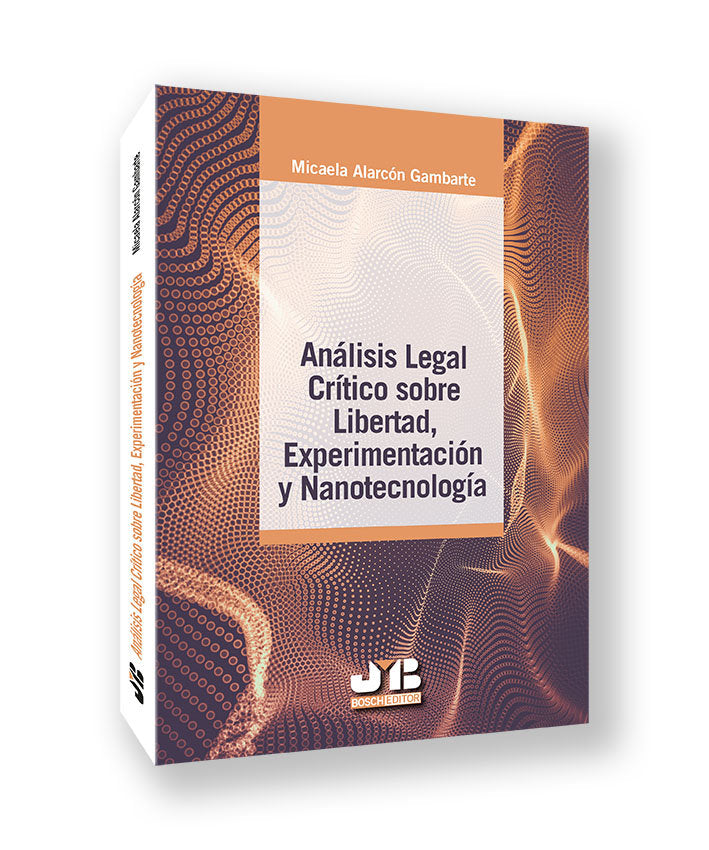

Description
CRITICAL LEGAL ANALYSIS ON FREEDOM, EXPERIMENTATION, AND NANOTECHNOLOGY
Book Summary
This work offers an exhaustive and critical legal study on the fundamental rights of freedom, autonomy, and bodily integrity in the face of 21st-century challenges. The author analyzes the normative evolution of freedom as a pillar of the democratic order, questions state pressure mechanisms in contexts of mandatory immunization, and examines the ethical and legal risks of nanotechnology applied to the human body. A rigorous analysis that combines constitutional law, legal philosophy, and anthropology to warn of potential rights violations in the name of technological progress.
What is it about?
The book addresses three major axes of critical legal analysis. First, it examines freedom as an essential fundamental right, analyzing its historical and normative evolution from a comparative constitutional perspective. The author questions the compatibility of indirect state pressures in contexts of mandatory immunization with international human rights standards.
Second, it delves into the principle of human dignity as an impassable limit to medical and scientific experimentation. It reviews historical precedents of serious violations, from the Nazi regime to contemporary clinical trials, to build a solid legal critique of the use of nanotechnology on human beings.
Finally, it analyzes the ethical, legal, and social risks of nanotechnology applied to the human body: the erosion of informed consent, the potential violation of the right to genetic privacy, and scenarios of control and surveillance through subdermal technologies. Through the symbol of the "Mark 666," it problematizes the legal scope of technological biocontrol.
Main Topics
- Fundamental rights and public liberties in the context of global health crises
- Constitutional limits to mandatory immunization and indirect state pressure mechanisms
- Human dignity as a legal barrier against medical and scientific experimentation
- Nanotechnology applied to the human body: informed consent, genetic privacy, and biocontrol
- Legal critique of technocratic models that threaten humanistic and rights-based constitutionalism
Who is it recommended for?
Intended for legal professionals, academics, researchers, legislators, and legal practitioners interested in contemporary ethical and legal challenges. It is also of great value to advanced students of constitutional law, human rights, and legal philosophy who seek a critical and protective perspective on the relationship between technology, experimentation, and fundamental freedoms.
What this book offers
- A rigorous and updated legal analysis on the compatibility of mandatory immunization policies with the constitutional block and international human rights standards
- A well-founded critique of the ethical and legal risks of nanotechnology applied to the human body, including the analysis of technological biocontrol
- A historical review of rights violations in experimentation contexts that serves as a legal warning for the present and the future
- Conceptual tools to understand and debate the limits of technological progress from a rights-based and humanistic perspective of the law
Technical Details
- Author: ALARCON GAMBARTE, MICAELA
- Publisher: J.M.BOSCH
- Language: Spanish
- Topic: INTERNATIONAL PROTECTION OF HUMAN RIGHTS, FUNDAMENTAL RIGHTS AND PUBLIC LIBERTIES
- Collection: LAW
- Edition Date: September 2025
- Number of pages: 210
- Weight: 400 g
Editorial Assessment
This work represents a significant contribution to the contemporary legal debate on the limits of state and technological intervention in the sphere of fundamental rights. The author combines a solid academic background in constitutional law with a critical gaze that transcends normative analysis to delve into the ethical and social implications of scientific advances. The book is especially pertinent at a time when health crises and technological development raise urgent questions about the balance between progress and the protection of individual freedoms. Its interdisciplinary approach and argumentative density make it a valuable tool for both academic reflection and legal practice.