
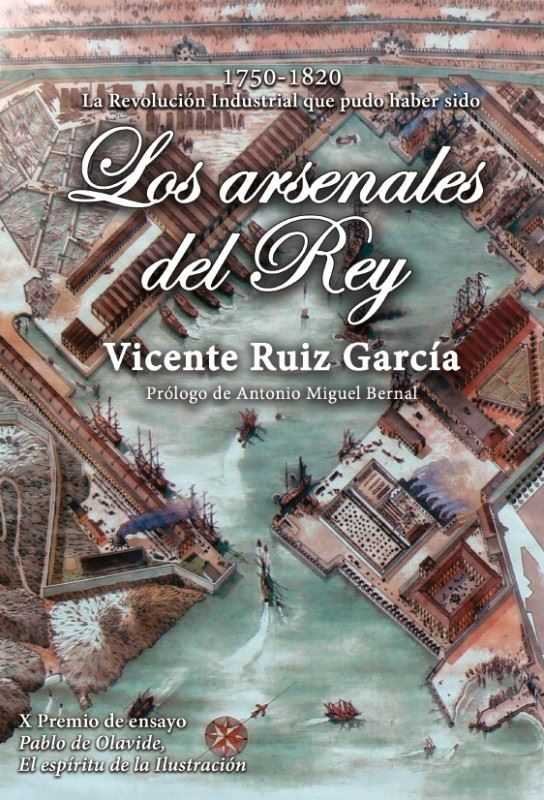

Description
The King's Arsenals
Book Summary
This work unveils a fascinating and little-known industrial espionage operation in 18th-century Spain. In the midst of the English Industrial Revolution, an agent in the service of the Spanish crown managed to recruit a group of British technicians to modernize the country's shipyards and naval construction. The reader will discover how this transfer of strategic knowledge was orchestrated, the geopolitical context that drove it, and its real impact on Spanish maritime power. A rigorous account that combines military history, secret diplomacy, and technological development.
What is it about?
The book focuses on the Spanish monarchy's attempt to overcome its naval technological lag compared to powers like England during the reigns of Ferdinand VI and Charles III. The narrative follows the figure of the spy who, acting as a double agent or recruiter, convinced English artisans, engineers, and naval architects to move to Spain. Through archival documents and correspondence, the author reconstructs the recruitment methods, the risks of betrayal, and the difficulties in applying British industrial secrets in the arsenals of Ferrol, Cartagena, and La Carraca. The work analyzes both the partial success of these missions and the internal resistance and limits of technological transfer in the Old Regime.
Main themes
- Industrial espionage and technology transfer in the 18th century
- History of Spanish shipbuilding and its arsenals
- Diplomatic relations and geopolitical conflicts between Spain and England
- The Industrial Revolution and its impact on naval power
- Biography of secret agents and British technicians in the service of the Spanish crown
Who is it recommended for?
This book is aimed at readers interested in the military and naval history of Spain, the history of technology and science, as well as those who enjoy historical espionage tales based on rigorous documentation. It will also be of great value to specialists in the 18th-century Spanish period, economic and industrial historians, and anyone curious about the hidden mechanisms of power and innovation in the Early Modern period.
What this book offers
- An original perspective on the modernization of the Spanish Navy, far removed from the clichés of decline.
- Detailed knowledge of a real industrial intelligence operation, with names, dates, and documents.
- Understanding of the practical difficulties in implementing foreign technology in a context of guilds and secrecy.
- A balanced analysis of the achievements and failures of Bourbon naval policy.
- An enjoyable read that combines academic rigor with the intrigue of a spy novel.
Technical specifications
- Author: Ruiz García, Vicente
- Publisher: Glyphos Publicaciones
- Language: Spanish
- Topic: History of Europe, Modern history up to the 20th century: c. 1700-, Military history
- Collection: None
- Binding: Paperback
- Publication date: December 2017
- Number of pages: 300
- Weight: 700 g
Editorial review
This is a specialized work that fills a significant historiographical gap: technological espionage in the naval sector during the Bourbon reforms. Its approach, based on primary sources, provides solidity to a story that might seem novelistic. Although its documentary density may require some familiarity with the period, the narrative structure facilitates immersion. Recommended for those seeking military and economic history far from conventional textbooks, featuring an unusual protagonist: the secret agent as an engine of industrial change.