
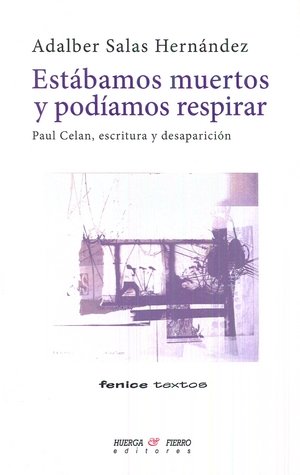

Description
WE WERE DEAD AND WE COULD BREATHE
Book Summary
In this work, Adalber Salas Hernández delves into the poetry of Paul Celan to explore the paradoxical relationship between writing and disappearance. The author analyzes how the poetic word can emerge from emptiness and absence, becoming an act of resistance and testimony. A profound essay that invites reflection on the limits of language and the capacity of poetry to name the unspeakable.
What is it about?
The book examines the work of the poet Paul Celan, a Holocaust survivor whose writing is characterized by a constant tension between the need to speak and the impossibility of doing so. Salas Hernández analyzes how Celan transforms the experience of trauma and death into poetry that, paradoxically, breathes from within death itself. Through a detailed study, the author unravels the literary mechanisms that allow Celan to construct a language that sustains itself upon silence and absence, offering a renewed reading of his legacy.
Main themes
- Poetry as a testimony to horror and historical memory.
- The relationship between writing, disappearance, and resistance.
- Language at the limit of the unspeakable and silence.
- The work of Paul Celan as a paradigm of contemporary poetry.
- The poetic act as a form of breathing amidst death.
Who is it recommended for?
This essay is aimed at readers interested in contemporary poetry, literary theory, and studies on memory and trauma. It is especially relevant for those who wish to delve into the work of Paul Celan, as well as for students and academics of literature, philosophy, and the humanities seeking a rigorous reflection on the limits of language and poetic creation.
What this book offers
- A detailed and original analysis of the poetics of Paul Celan, one of the most influential poets of the 20th century.
- A profound reflection on the power of the word to confront the experience of horror and disappearance.
- Keys to understanding how poetry can articulate silence and absence as constructive elements.
- A critical perspective that connects Celan's work with current debates on memory, testimony, and representation.
Technical specifications
- Author: Salas Hernández, Adalber
- Publisher: Huerga y Fierro Editores
- Language: Spanish
- Subject: Literary essays, literary studies: poetry and poets
- Collection: Essay
- Binding: Paperback
- Publication date: April 2017
- Number of pages: 210
- Weight: 295 g
Editorial review
We Were Dead and We Could Breathe is presented as an essential work for those seeking to understand the complexity of Paul Celan's poetry. Adalber Salas Hernández achieves a rigorous and accessible essay that illuminates key aspects of Celanian writing, offering the reader tools to enter one of the most challenging and significant poetic universes of the 20th century. His approach, centered on the paradox of writing from disappearance, makes it a valuable read for both specialists and enthusiasts of poetry and contemporary thought.