
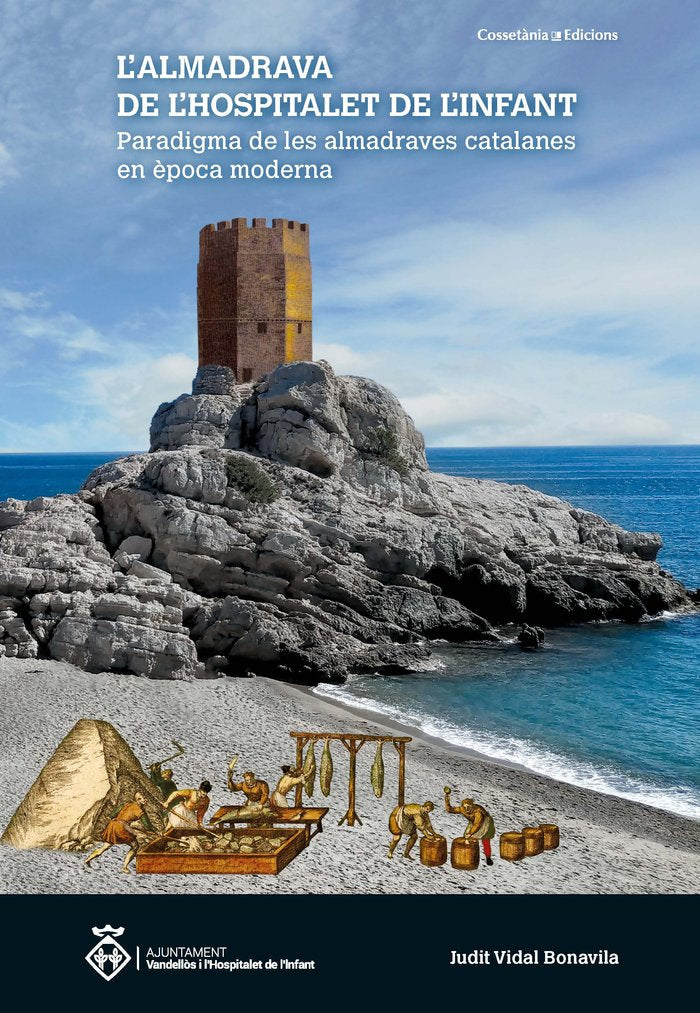

Description
LALMADRAVA LHOSPITALET LINFANT PARADIGM OF CATALAN TUNNY NETS
Book Summary
This work offers an exhaustive analysis of the "almadrabas"—a historical fishing technique used for catching tuna, one of the most valued fish throughout time. The author, Judit Vidal, focuses on the paradigm of L'Hospitalet de l'Infant as a representative case study of Catalan tunny nets, exploring their evolution from classical antiquity to the present day. The reader will discover how this fishing technique, present throughout the Mediterranean, had a significant impact on the Catalan coast, combining local history, maritime tradition, and cultural heritage.
What is it about?
The book examines in depth the history and development of tunny nets in Catalonia, using the model of L'Hospitalet de l'Infant as a reference. Through detailed research, the author unravels the origins of this tuna fishing technique, which dates back to classical antiquity, and analyzes its technical and social evolution over the centuries. The work places the Catalan case within the Mediterranean context, showing how this practice was not only a key economic activity but also generated a rich cultural and social legacy in coastal communities. It addresses changes in fishing methods, the organization of labor, and the importance of tuna as a resource, offering a complete view of a craft that shaped the identity of numerous towns.
Main themes
- History of tuna fishing in the Mediterranean.
- Tunny nets as a traditional fishing technique and their evolution.
- Case study of L'Hospitalet de l'Infant as a paradigm of Catalan tunny nets.
- Economic, social, and cultural impact of tuna fishing on the Catalan coast.
- Maritime heritage and local fishing traditions.
Who is it recommended for?
This book is aimed at readers interested in the local and maritime history of Catalonia, as well as those passionate about the anthropology of fishing and Mediterranean traditions. It will also be of great value to students and researchers of economic and social history, and to anyone who wishes to gain an in-depth understanding of an ancestral craft that has shaped the lives of coastal communities.
What this book offers
- A rigorous and contextualized analysis of Catalan tunny nets, with a local focus connected to the Mediterranean reality.
- A detailed vision of the historical evolution of a key fishing technique, from its origins to the contemporary era.
- An understanding of the heritage and cultural value of tuna fishing, beyond its purely economic aspect.
- A case study that serves as a model for understanding similar dynamics in other coastal regions.
Technical specifications
- Author: VIDAL,JUDIT
- Publisher: Cossetània Edicions
- Language: cat
- Subject: HISTORY, LOCAL HISTORY
- Collection: LES NOSTRES ARRELS
- Binding: Paperback
- Publication date: April 2019
- Number of pages: 160
- Weight: 396 g
Editorial review
This work represents a solid and specialized contribution to the knowledge of Catalan fishing history. Its focus on the case of L'Hospitalet de l'Infant allows for a deep and concrete analysis, avoiding generalizations. Judit Vidal's research provides a valuable perspective for understanding the relevance of tunny nets not only as a technique but as a cultural phenomenon. It is a recommended read for those looking for a well-documented and accessible study on a little-known aspect of Mediterranean maritime heritage.