
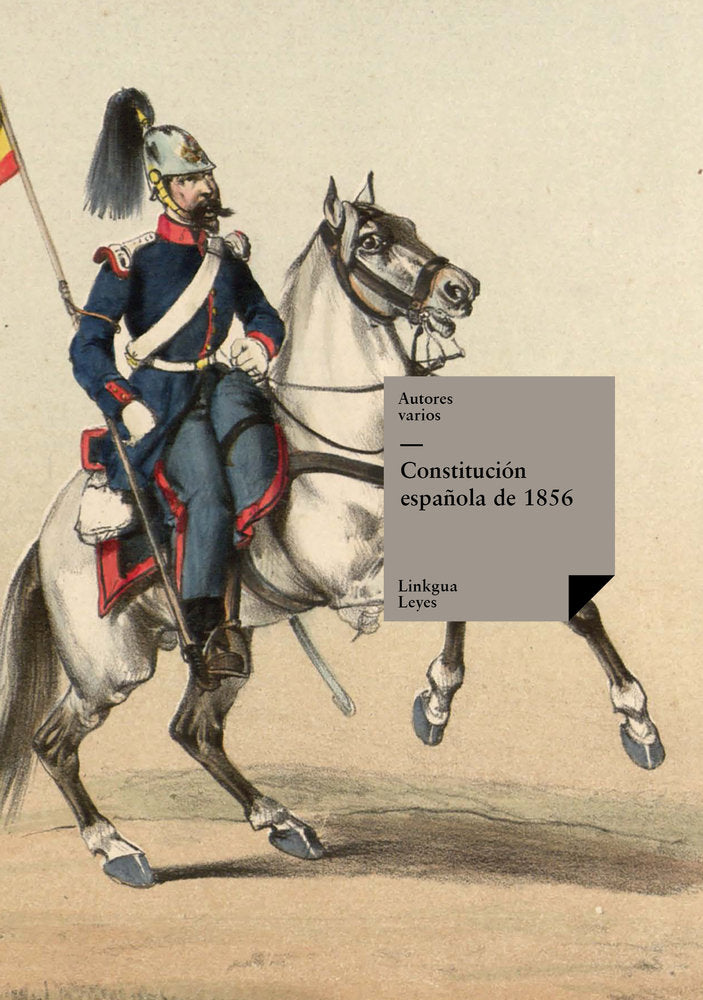

Description
Spanish Constitution of 1856
Book Summary
This work presents the complete text of the Spanish Constitution of 1856, known as the "non nata" (the unborn) because it was never promulgated due to General Leopoldo O'Donnell's coup d'état. The reader will find a document with a liberal spirit that, despite its brief political tenure, laid the foundations for progressive constitutionalism in Spain. The main value of this edition lies in offering direct access to a key text that anticipated fundamental rights and democratic principles, such as national sovereignty, religious tolerance, and universal suffrage, which would later be consolidated in the Constitution of 1869.
What is it about?
The Spanish Constitution of 1856 was the result of the Constituent Cortes elected in 1854, during the progressive biennium. This constitutional draft, with a distinctly liberal and progressive character, reaffirmed the principle of national sovereignty and broadly recognized the political rights of citizens. For the first time in Spanish constitutional history, a regime of religious tolerance was introduced, which generated intense parliamentary debate. Furthermore, the Cortes discussed innovative democratic criteria for the time, such as religious freedom, universal suffrage, social rights, the right to protest, and the possibility of replacing the monarchy with a republic. Although O'Donnell's coup d'état prevented its promulgation, this text formed the doctrinal and structural basis of the future Constitution of 1869, becoming a milestone in Spanish liberal political thought.
Main themes
- National sovereignty and its reaffirmation as the founding principle of the State.
- Religious tolerance and the debate on freedom of worship in 19th-century Spain.
- Political and civil rights, including universal suffrage and the right to protest.
- Debate on the form of State: monarchy versus republic.
- Evolution of Spanish constitutionalism and its influence on the Constitution of 1869.
Who is it recommended for?
This book is aimed at students and professionals of law, history, and political science, as well as any reader interested in the evolution of Spanish constitutionalism and the liberal movements of the 19th century. It is also very useful for researchers who wish to consult the primary source of a constitutional text that, although it was not promulgated, marked a turning point in progressive political thought in Spain.
What this book provides
- Direct access to the original text of a constitution fundamental to understanding the transition from doctrinaire to democratic liberalism in Spain.
- Understanding of the political and social debates that preceded the Constitution of 1869, considered the first Spanish democratic constitution.
- Historical perspective on the struggle for civil rights and religious freedom in the 19th century.
- Essential study material for the comparative analysis of historical Spanish constitutionalism.
- Manageable and affordable edition, ideal for quick reference and academic study.
Technical specifications
- Author: Various Authors
- Publisher: Linkgua Ediciones
- Language: Spanish
- Topic: CLASSIC TEXTS
- Collection: LAWS
- Binding: Paperback
- Edition date: May 2025
- Number of pages: 54
- Weight: 100 g
Editorial review
This edition of the Spanish Constitution of 1856 offers unquestionable historical and documentary value. As a "non nata" text, its study is essential to understanding the political tensions of 19th-century Spain and the development of liberal constitutionalism. Its pocket-sized format and low page count make it easy to use as a reference work. It is a recommended acquisition for those who wish to delve into the roots of the Spanish democratic system and the debates that shaped contemporary Spain.