
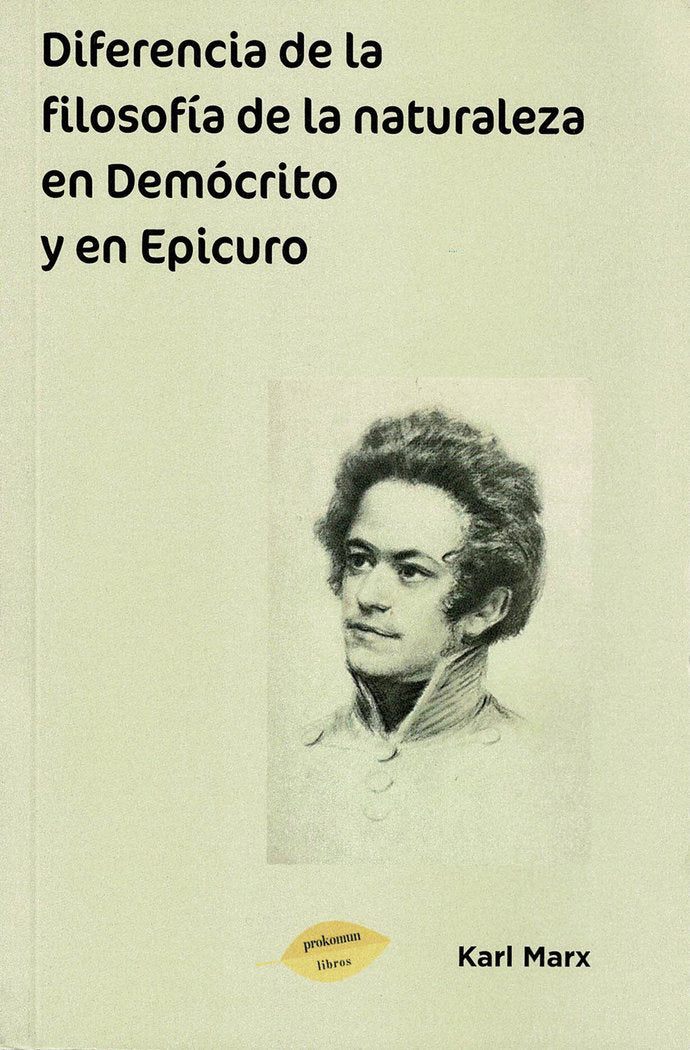

Description
Difference Between the Philosophy of Nature in Democritus and Epicurus
Book Summary
In this early work, Karl Marx approaches the philosophy of nature from a critical perspective, comparing the views of Democritus and Epicurus. The author defends human self-consciousness as the supreme principle, challenging traditional divine conceptions. This text, published in the PROKOMUN collection, offers a profound reflection on ancient materialism and its relevance to modern thought, presenting Epicurus as a precursor to individual freedom against mechanistic determinism.
What is it about?
Marx analyzes the fundamental differences between the philosophies of nature of Democritus and Epicurus, two atomist thinkers of antiquity. While Democritus proposes a universe governed by mechanical and necessary laws, Epicurus introduces the concept of the spontaneous deviation of atoms (the clinamen), which allows for freedom and contingency. Through this contrast, Marx vindicates Epicurean philosophy as an affirmation of human self-consciousness, capable of rebelling against any form of divine or material determinism. The text, imbued with a Promethean tone, argues that philosophy must maintain its independence and criticize any authority that does not recognize the primacy of the human being.
Main themes
- Comparison between the mechanistic atomism of Democritus and the contingent atomism of Epicurus.
- Defense of human self-consciousness as the supreme philosophical principle.
- Critique of determinism and traditional divine conceptions.
- Vindication of individual freedom against natural necessity.
- The role of philosophy as a tool for intellectual emancipation.
Who is it recommended for?
This book is aimed at students and specialists in philosophy interested in the thought of Marx, ancient philosophy, and the history of materialism. It is also suitable for readers seeking to understand the roots of critical thought and the theory of emancipation, as well as those who wish to explore the connections between classical and modern philosophy.
What this book contributes
- An original view of Epicurus's philosophy as a precursor to freedom and self-consciousness.
- A detailed analysis of the differences between two currents of ancient atomism.
- A reflection on the role of philosophy as a critique of authority and tradition.
- An early perspective on Marx's thought, before his economic and political development.
- A defense of contingency and freedom against mechanistic determinism.
Technical specifications
- Author: Marx, Karl
- Publisher: Mandala Ediciones
- Language: Spanish
- Subject: SOCIAL AND POLITICAL PHILOSOPHY
- Collection: PROKOMUN
- Binding: Paperback
- Date of publication: November 2022
- Number of pages: 120
- Weight: 99 g
Editorial review
This edition by Mandala Ediciones recovers a fundamental text by the young Marx, where the foundations of his critical thought are glimpsed. The work offers a rigorous and passionate reading of ancient philosophy, connecting it with modern concerns about freedom and self-consciousness. It is a recommended choice for those seeking to understand Marx's intellectual evolution and his commitment to an emancipatory philosophy.