
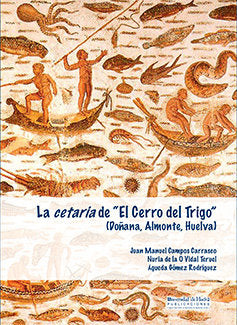

Description
The "El Cerro del Trigo" Cetaria
Book Summary
This work offers an exhaustive study of the archaeological site of "El Cerro del Trigo," located in Doñana National Park. Through a combination of new archaeological interventions and a review of data from early 20th-century excavations, the authors reconstruct the history of one of the most important cetariae (fish salting factories) in the Gulf of Cádiz in antiquity. The book reveals the industrial reality of the enclave, moving away from interpretations that linked it to the mythical city of Tartessos, and provides a renewed and detailed view of its functionality and historical relevance.
What is it about?
The research focuses on a comprehensive analysis of the "El Cerro del Trigo" site, a key location for understanding the fishing and salting industry in Roman Hispania. The authors integrate the results of surface and geophysical surveys, manual soundings, and cleaning of specific areas, along with geomorphological analyses. This multidisciplinary approach allows for a deep understanding of the structure and operation of the cetaria, dismantling previous theories that associated it with the legendary Tartessos. The book demonstrates that the enclave was, in reality, a first-rate production center in the Gulf of Cádiz, offering a well-founded reinterpretation of its past.
Main Topics
- Archaeology of production and the fish salting industry in antiquity.
- Critical review of archaeological historiography on Tartessos and the Lower Guadalquivir.
- Archaeological methodology: integration of geophysical prospecting, soundings, and geomorphological analysis.
- Economic and social history of the Huelva coastline during the Roman period.
- Study of cetariae as processing factories for marine resources.
Who is it recommended for?
This book is aimed at archaeologists, historians, undergraduate and graduate students in Archaeology and Ancient History, as well as researchers specializing in the Roman fishing industry and the protohistory of the southwestern Iberian Peninsula. It will also be of great interest to archaeology enthusiasts with an advanced level of knowledge and any reader interested in the revision of historical myths such as that of Tartessos from a rigorous scientific perspective.
What this book contributes
- A well-founded reinterpretation of a key site, distanced from myths and based on updated empirical data.
- A methodological model for how to approach the study of an archaeological site using combined techniques and critical review of sources.
- Detailed information on the organization and operation of a large-scale Roman cetaria in the Gulf of Cádiz.
- A significant contribution to the knowledge of industrial archaeology and the maritime economy of Roman Hispania.
Technical Data
- Author: Campos Carrasco, Juan Manuel; Vidal Teruel, Nuria de la O; Gómez Rodríguez, Águeda
- Publisher: University of Huelva
- Language: Spanish
- Subject: HISTORY, ARCHAEOLOGY, ARCHAEOLOGY BY PERIOD/REGION
- Collection: ARIAS MONTANO
- Binding: Other
- Publication Date: Not available
- Number of pages: 406
- Dimensions: Not available
- Weight: 886 g
Editorial Review
This is a rigorous research work that provides notable documentary and methodological value to the field of Roman archaeology on the Iberian Peninsula. Its main interest lies in the authors' ability to update and correct established historical interpretations, offering a more precise vision of a relevant industrial enclave. It is an essential read for specialists seeking primary data and a critical analysis of the salting industry in the Doñana area, as well as for those interested in the evolution of the archaeological debate regarding Tartessos.