
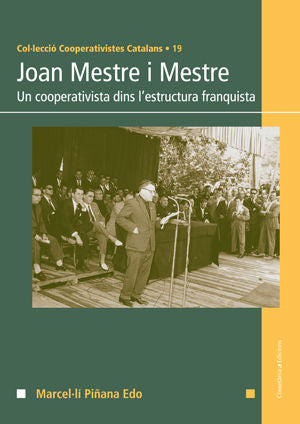

Description
JOAN MESTRE MESTRE
Book Summary
This work offers a comprehensive portrait of Joan Mestre i Mestre, a key figure in understanding Catalan agricultural cooperativism during the Franco era. The reader will discover the trajectory of a man who, from the presidency of the Riudecols Agricultural Cooperative and the Territorial Union of Cooperatives of the Camp, fought to improve the conditions of farmers. The book analyzes his ability to navigate within the Francoist vertical trade union system, achieving milestones such as the liberalization of the dried fruit trade in 1956. An essential biography for anyone who wants to understand the complexities of the rural world and its power structures during the 20th century.
What is it about?
The book recounts the life of Joan Mestre i Mestre (Riudecols, 1908-1977), a man of farming origin who, after working as the secretary of his town hall, became actively involved in agricultural cooperativism. His sensitivity to the precariousness of post-war farmers led him to revitalize the Riudecols Agricultural Cooperative and, subsequently, the Territorial Union of Cooperatives of the Camp (UTECO), based in Reus. As a board member of the entity, he was the architect of the freedom of trade in dried fruit in 1956. Later, as president of UTECO, he joined Francoist politics, becoming a member of the Cortes for the Syndical Third (1967-1971) and the Family Third (1971-1975). The work details how, during the last twenty-five years of his life, he exploited the structures of the Francoist system to defend the interests of agriculture in the Camp de Tarragona and Terres de l'Ebre regions, from the presidency of the Reus Agricultural Union.
Main themes
- Biography of Joan Mestre i Mestre, a Catalan cooperative leader.
- Agricultural cooperativism in Catalonia during the Franco era.
- The struggle to improve farmers' conditions in the post-war period.
- The liberalization of the dried fruit trade in 1956.
- The relationship with and use of the Francoist vertical trade union system for the defense of agricultural interests.
- The history of the Camp de Tarragona and Terres de l'Ebre regions in the 20th century.
Who is it recommended for?
This book is recommended for historians, scholars of cooperativism and the rural world, as well as for readers interested in the social and political history of 20th-century Catalonia. It is also of great interest to those who want to understand the power dynamics and the strategies of survival and defense of agrarian interests during the Franco period. Profiles such as historical biography enthusiasts and members of agricultural cooperatives will find in this work a valuable source of knowledge.
What this book contributes
- A detailed vision of the figure of Joan Mestre, a key character who is often little known.
- Understanding of action strategies within cooperativism under the Franco dictatorship.
- Historical and social context of the farmers' struggle in the Camp de Tarragona and Terres de l'Ebre.
- Analysis of how the regime's structures could be leveraged for the defense of sectoral interests.
- A case study on tenacity and leadership in the service of an agricultural community.
Technical sheet
- Author: PIÑANA EDO, MARCELI
- Publisher: COSSET·NIA
- Language: cat
- Subject: BIOGRAPHY: GENERAL, BIOGRAPHY: HISTORICAL, POLITICAL AND MILITARY
- Collection: COOPERATIVISTES CATA
- Binding: Paperback
- Publication date: June 2012
- Number of pages: 96
- Weight: 237 g
Editorial review
This is a concise yet well-documented biography that succeeds in highlighting the figure of a man who, from within the system, worked tirelessly for his sector. The work is particularly relevant for its ability to show the contradictions and possibilities of action within the framework of Francoism. Despite its brevity, it offers a deep analysis of the cooperative and political structures of the time, becoming an essential read for anyone interested in the recent agricultural and political history of Catalonia.