
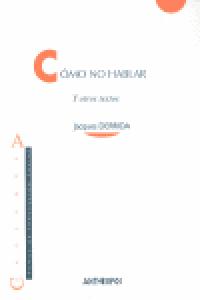

Description
How to Not Speak
Book Summary
In "How to Not Speak," Jacques Derrida, a central figure in contemporary thought, delves into his project of deconstruction through a general science of writing: grammatology. This work brings together key texts that expose the multiplicity of spaces where his discourse unfolds, offering the reader a gateway into the peculiar style of his writing and the horizons of a new way of thinking. The book constitutes a radical critique of Western culture and thought, exploring the limits of language and the paradoxes of expression.
What is it about?
This volume collects a series of fundamental texts by Jacques Derrida that address deconstruction as a method of critical analysis. The work focuses on grammatology, a general science of writing that questions traditional hierarchies between speech and writing, serving as a starting point for a profound critique of the foundations of Western thought. Through a dense and provocative style, Derrida examines how language, far from being a simple vehicle of meaning, is a field of tensions, differences, and deferrals. The reader will find a rigorous analysis of the limits of communication and the conditions of possibility for any discourse.
Main themes
- Deconstruction as a philosophical and critical method.
- Grammatology and the general science of writing.
- Radical critique of Western culture and thought.
- Limits of language and paradoxes of expression.
- Relationship between speech, writing, and meaning.
Who is it recommended for?
This book is aimed at advanced students and specialists in philosophy, literary theory, linguistics, and cultural studies. It will also be of great interest to readers with a solid background in contemporary thought who wish to delve into the work of one of the most influential and complex philosophers of the 20th century. A willingness to engage with a dense writing style and thought that challenges established conventions is required.
What this book contributes
- A deep understanding of Derrida's deconstructive project through core texts.
- Conceptual tools for critically analyzing the foundations of language and culture.
- Access to the style and methodology of one of the most original thinkers in contemporary philosophy.
- A renewed perspective on the relationships between writing, meaning, and power.
Technical specifications
- Author: DERRIDA, JACQUES
- Publisher: ANTHROPOS EDITORIAL
- Language: Spanish
- Subject: PHILOSOPHY OF LANGUAGE, LITERATURE AND LITERARY STUDIES, LITERARY ESSAYS, ETHICS AND MORAL PHILOSOPHY
- Collection: CUADERNOS A NUEVOS TERRITORIOS
- Binding: Other
- Edition date: November 2011
- Number of pages: 160
- Weight: 293 g
Editorial review
This edition of "How to Not Speak" offers a selection of essential texts for those seeking a rigorous immersion in the thought of Jacques Derrida. Its value lies in presenting, in an accessible format, some of the most representative writings of his deconstructive project. The work is especially useful for academics and students who wish to engage directly with the source of concepts that have marked contemporary philosophy and critical theory, although its reading requires a high level of familiarity with philosophical debate.