
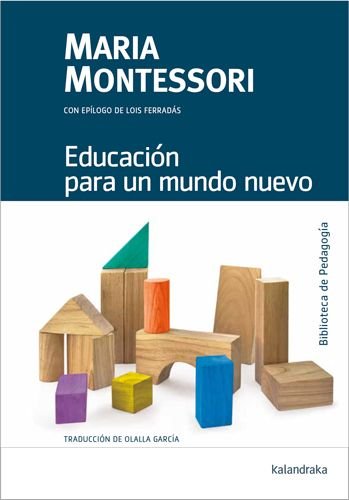

Description
Education for a New World
Book Summary
In Education for a New World, Maria Montessori sets forth her revolutionary pedagogical vision, the result of lectures she delivered in India. This book captures the essence of a method that places the child at the active center of learning, advocating for freedom, autonomy, and sensory development as the cornerstones for shaping responsible and peaceful individuals. A fundamental work for understanding the principles that transformed 20th-century education and remain relevant today.
What is it about?
The work compiles the lectures Maria Montessori gave in India, a country where her pedagogy was supported by figures such as Tagore and Gandhi. Within these pages, the author explains how her method, based on the scientific observation of the child, proposes an educational environment that fosters autonomy, initiative, and self-education. Montessori advocates for sensory education and the use of specific materials that allow for self-learning, always in connection with nature. She focuses particularly on the 0 to 3 age group, promoting Children's Houses as an alternative to traditional daycares, with a clear universalist and pacifist orientation.
Main Topics
- Montessori pedagogy and its practical application.
- The child as the active protagonist of the educational process.
- Sensory education and materials for self-learning.
- Development of autonomy, responsibility, and the child's will.
- The importance of early childhood (0-3 years) and Children's Houses.
Who is it recommended for?
This book is aimed at educators, pedagogues, psychologists, and students of educational sciences who wish to learn the foundations of the Montessori method firsthand. It is also an essential read for parents interested in respectful parenting and in understanding how to foster their children's autonomous development from early childhood.
What this book contributes
- Direct access to Maria Montessori's original thought through her lectures.
- Deep understanding of the principles of freedom, autonomy, and self-education in learning.
- Conceptual tools to apply a pedagogy based on observation and respect for the child.
- A pacifist and universalist vision of education as a driver of social change.
Technical Specifications
- Author: Maria Montessori
- Publisher: Kalandraka
- Language: Spanish
- Subject: Philosophy and Theory of Education
- Collection: Library of Pedagogy
- Binding: Paperback
- Publication Date: May 2026
- Number of pages: 144
- Weight: 372 g
Editorial Assessment
Education for a New World is a reference work for those seeking to understand the foundations of Montessori pedagogy. Its value lies in presenting, in a direct and accessible way, the ideas the author developed in a key international context. It is a concise yet profound text, ideal both for getting started with the method and for delving deeper into its most essential principles, offering a current perspective on how to educate for freedom and peace.