
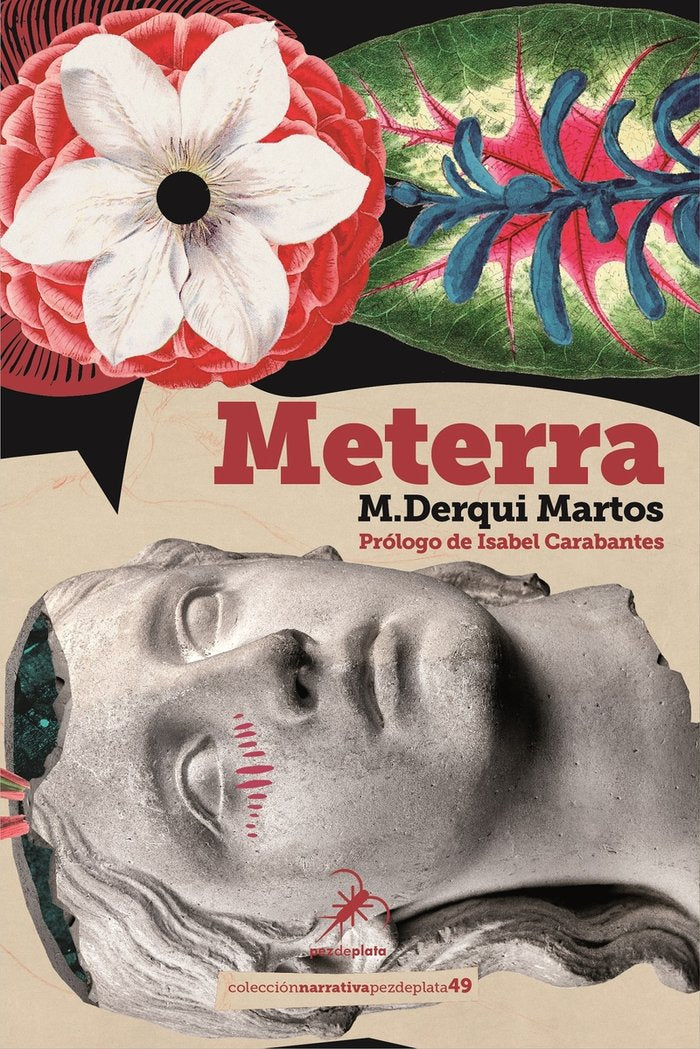

Description
METERRA
Book Summary
Meterra is the imaginary biography of a painter who fails as a man and an artist, a forgotten masterpiece of the Spanish literary avant-garde. Written between 1955 and 1963 and published in 1974, this bold and experimental novel weaves a vital odyssey in which Juan, the protagonist, leaves his native Zaragoza to seek his fortune in Paris. What begins as a childhood memory transforms into a sinister and mythical landscape, an inaccessible territory that gives the work its title. With echoes of Joyce, Proust, Kafka, and Faulkner, the reader is immersed in a journey toward destruction, populated by broken dreams, failed romances, and a Kafkaesque atmosphere that defies conventional narrative.
What is it about?
The novel follows the trajectory of Juan, an antihero who, from his childhood in Zaragoza, pursues an artistic dream that leads him to Paris, the cultural hotbed of the era. However, the city becomes the setting for his personal and professional decline. Through a fragmented and experimental structure, the work explores the protagonist's impossibility of accessing "Meterra," a mythical territory that symbolizes a lost paradise or an unattainable goal. The narration unfolds through streams of consciousness, lexical games, musical devices, and hellish dialogues, creating an oppressive and dreamlike environment. Juan faces hostile secondary characters, pestilent diseases, and wrathful beasts in an uninhabitable city, while his identity unravels and his failure becomes inevitable. The work is a rhetorical litany that combines provincial neorealism with deep psychological exploration, offering a unique and challenging literary experience.
Main Themes
- The artistic and existential failure of the modern antihero.
- The search for a lost paradise or inaccessible mythical territory.
- Alienation and personal decline in a hostile urban environment.
- Narrative experimentation through stream of consciousness and personal symbolism.
- A critique of the cultural avant-garde and its unfulfilled promises.
Who is it recommended for?
This book is aimed at readers passionate about experimental narrative and avant-garde literature. It is ideal for those who enjoy complex works that challenge traditional structures, with influences from authors such as Joyce, Kafka, or Faulkner. It will also be attractive to scholars of 20th-century Spanish literature interested in rediscovering forgotten gems, and to those seeking a profound, symbolic, and psychologically intense read.
What this book offers
- An innovative reading experience that combines advanced narrative techniques with rich, symbolic prose.
- The opportunity to rediscover a pioneering work of the Spanish literary avant-garde, ahead of its time.
- A lucid and heartbreaking portrait of human and artistic failure, explored from a deep psychological perspective.
- A literary journey through dreamlike and mythical territories that invite reflection on identity and memory.
Technical Specifications
- Author: Manuel Derqui Martos
- Publisher: Editorial Pez de Plata, S.L.
- Language: Spanish
- Subject: Modern and contemporary fiction
- Collection: Narrativa Pez de Plata
- Binding: Paperback
- Publication date: November 2024
- Number of pages: 520
- Weight: 1223 g
Editorial Review
Meterra stands as an essential editorial recovery for lovers of experimental literature. Its original publication in 1974, despite the delay, does not diminish the value of a work that, due to its formal ambition and thematic depth, deserves a prominent place in 20th-century Spanish narrative. Manuel Derqui Martos's novel is an intellectual challenge that rewards the reader with a unique aesthetic and emotional experience, although its complexity may not be suitable for those seeking a light read. It is, without a doubt, a key piece for understanding the innovative currents of its time and a discovery for any literary library.