
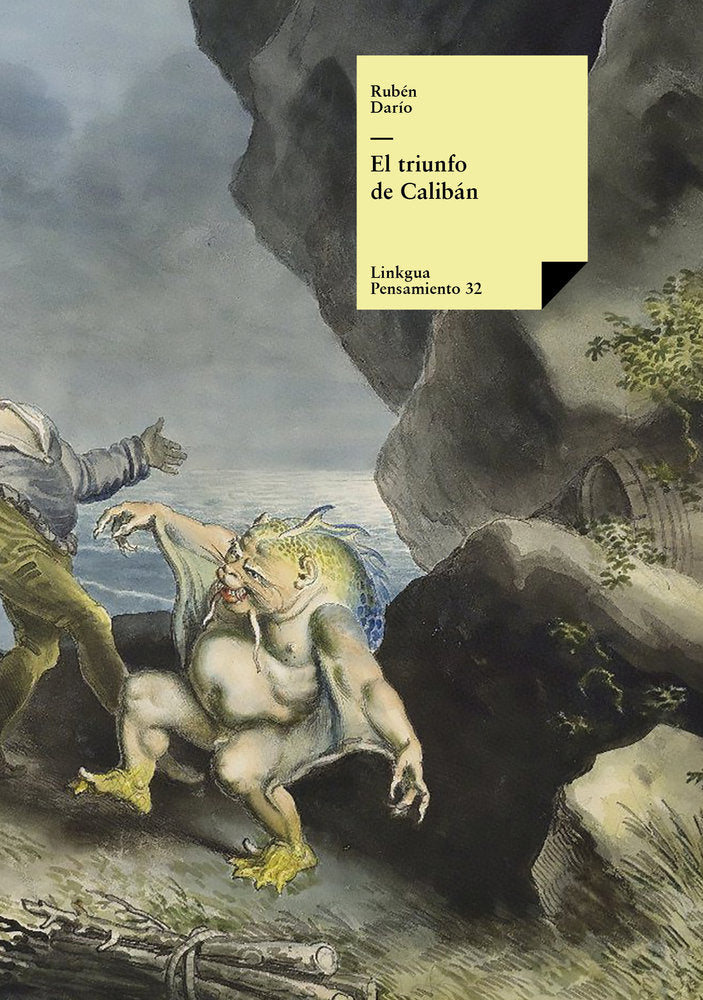

Description
The Triumph of Caliban
Book Summary
This work gathers essays, poems, and stories by Rubén Darío that express his critical and contradictory vision of the United States at the end of the 19th century. Through the Shakespearean metaphor of Caliban and Ariel, the author denounces American expansionism and defends the Hispanic American cultural identity. The reader will find an anthology that combines political analysis, social denunciation, and lyricism, offering a key perspective on the region's fin-de-siècle unrest.
What is it about?
The book is structured around the original publication of "The Triumph of Caliban," which appeared in 1898 in Buenos Aires and Caracas, in the midst of the Spanish-American War. Rubén Darío uses Shakespeare's characters to represent the conflict between the colonizer (Caliban) and the colonized (Ariel). While Caliban symbolizes the expansionist barbarism of the United States, which imposes force over reason, Ariel embodies the noble spirit of the enslaved indigenous person. The anthology includes pieces such as "To Roosevelt," "The Swans," "Salutation to the Eagle," "To Columbus," "Huitzilopoxtli: Mexican Legend," and a fragment from his Autobiography, which together offer a complex and sometimes contradictory vision of American power and its effects on Latin America.
Main Themes
- Critique of American imperialism and its expansionism at the end of the 19th century
- The metaphor of Caliban and Ariel as a representation of the relationship between colonizer and colonized
- Defense of the Hispanic American cultural identity in the face of foreign influence
- Fin-de-siècle unrest and the crisis in Spain following the loss of Cuba and Puerto Rico
- The contradiction in Rubén Darío's view of the United States, torn between admiration and rejection
Who is it recommended for?
This book is aimed at readers interested in classic Hispanic American literature, political essays, and poetry from the late 19th century. It is also suitable for those studying the thought of Rubén Darío, the relationship between Latin America and the United States, or the historical context of the Spanish-American War. It will be of special interest to students of literature, history, and political science who seek to understand the roots of anti-imperialism in the region.
What this book provides
- An anthology that collects the key pieces of Rubén Darío's political thought regarding the United States
- A deep analysis of the Shakespearean metaphor applied to the Hispanic American reality
- A historical and cultural view of the fin-de-siècle unrest in Latin America
- Texts that combine essay, poetry, and narrative to offer a multifaceted perspective
- An autobiographical fragment that contextualizes the author's personal evolution
Technical Specifications
- Author: Darío, Rubén
- Publisher: Linkgua Ediciones
- Language: Spanish
- Topic: CLASSIC TEXTS
- Collection: THOUGHT
- Binding: Paperback
- Number of pages: 42
- Weight: 100 g
Editorial Assessment
This edition from Linkgua Ediciones offers a carefully curated selection of Rubén Darío's work that is useful for both the specialized reader and those approaching his political thought for the first time. The brevity of the volume (42 pages) makes it an accessible read, even though it concentrates texts of great symbolic and historical density. The inclusion of lesser-known pieces, such as "Huitzilopoxtli," enriches the anthology and allows one to appreciate the author's complexity. It is a recommended work for those who wish to explore the contradictions of Hispanic American modernism in the face of American power.