
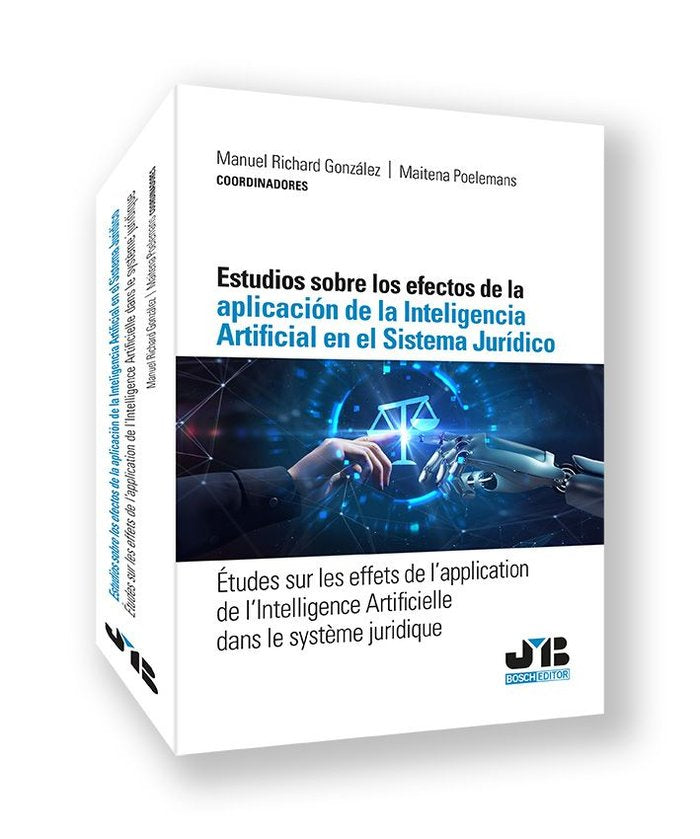

Description
STUDIES ON THE EFFECTS OF ARTIFICIAL INTELLIGENCE APPLICATION
Book Summary
This collective work, the result of the cross-border working group RetrIA, brings together research from professors at Spanish and French universities regarding the impact of artificial intelligence in the legal sphere. The reader will find a multidisciplinary analysis covering everything from legal philosophy and public policy to the practical application of AI in the courts. It is an essential tool for understanding the legal, ethical, and procedural challenges posed by this technology, offering a rigorous and comparative view of its regulatory and judicial development.
What is it about?
The book exhaustively explores how artificial intelligence is transforming the law from multiple angles. It examines the philosophical foundations and ethical debates underlying AI regulation, as well as its influence on geopolitics and public policy. From a procedural perspective, the use of AI tools in judicial investigation and court decision-making is analyzed. Furthermore, it addresses issues of comparative law, private international law, and consumer protection, offering a complete panorama of the legal effects of this technology in national and international contexts.
Main Topics
- Philosophy of law and ethical foundations of artificial intelligence.
- Geopolitics and public policy in AI regulation.
- Procedural law and the use of artificial intelligence in investigation and prosecution.
- Comparative law between Spanish and French legal systems.
- Protection of consumers and users against automated systems.
- Private international law and conflicts of laws in the digital environment.
Who is it recommended for?
It is aimed at jurists, lawyers, judges, prosecutors, academics, and law students interested in the impact of technology on the legal system. It is also highly useful for professionals in legal philosophy, political science, and public administration who seek to understand the regulatory challenges of artificial intelligence. Researchers and public policy makers will find in this work a rigorous and updated analysis to support their work and decisions.
What this book provides
- A multidisciplinary and comparative view (Spain-France) of the legal regulation of artificial intelligence.
- Detailed analysis of how AI affects specific branches of law, from procedural to private international law.
- Well-founded reflections on the ethical and philosophical dilemmas posed by the automation of judicial decisions.
- Conceptual tools to address the protection of consumers and users in algorithmic environments.
Technical Specifications
- Author: Richard Gonzalez, Manuel; Poelemans de la
- Publisher: J.M. Bosch Editor
- Language: Spanish
- Subject: Ethical issues and debates, Geopolitics, Philosophy of law, Comparative law, Private international law and conflict of laws, Procedural law, Consumer and user protection
- Collection: TBD Collection
- Binding: Paperback
- Publication Date: January 2025
- Number of pages: 672
- Weight: 1150 g
Editorial Review
This work stands as an essential reference for those who need to understand the intersection between law and artificial intelligence from an academic and practical perspective. Its cross-border focus and the diversity of topics covered make it a valuable resource for specialists seeking deep and up-to-date analysis. The breadth of its content and the rigor of its contributors position it as a mandatory reference tool in a rapidly evolving field.