
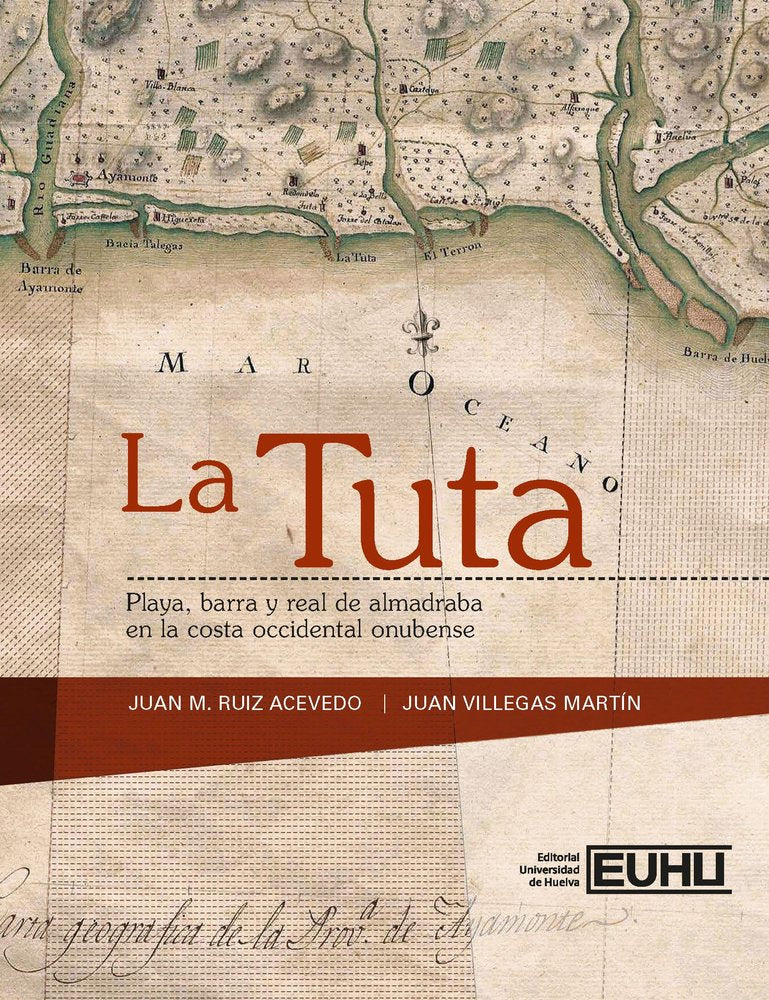

Description
LA TUTA
Book summary
This work rescues from oblivion the history of one of the most unique tuna fishing enclaves on the western coast of Huelva. Through a combination of documentary sources, historical cartography, and geographical studies, the authors reconstruct the evolution of the Tuta sandbar and camp from the 16th century until its disappearance in the 19th. The book not only addresses the technical and economic aspects of the almadraba (tuna trap fishery) but also illuminates its cultural and heritage dimension, linked to the coastal communities that lived off tuna fishing. With a meticulous style and rich graphic support, this research becomes a benchmark for understanding the deep relationship between human beings, the sea, and the Huelva territory.
What is it about?
The work focuses on the historical and geographical study of La Tuta, a tuna fishing enclave located on the western coast of Huelva. The authors analyze its evolution from the first documentary mentions in the 16th century until its disappearance in the 19th century, combining written sources, historical cartography, and geographical studies. The book examines both the technical and economic aspects of the almadraba and its cultural and heritage dimension, showing how this place was intrinsically linked to the coastal communities that depended on tuna fishing. Through an interdisciplinary approach, the research restores prominence to La Tuta as an essential part of the tuna fishing and maritime heritage of Andalusia.
Main themes
- History of the almadraba on the western coast of Huelva
- Geographical and cartographic evolution of the Tuta sandbar and camp
- Relationship between coastal communities and tuna fishing
- Cultural and maritime heritage of Andalusia
- Documentary and geographical analysis of a vanished enclave
Who is it recommended for?
This book is aimed at specialists in history, archaeology, and geography, as well as researchers interested in the maritime and fishing history of Andalusia. It is also of great interest to readers passionate about the cultural and natural heritage of the Huelva coastline, and to anyone who wishes to understand the deep relationship between human beings, the sea, and the territory through the study of a unique tuna fishing enclave.
What this book contributes
- Rescues from oblivion the history of a key tuna fishing enclave on the coast of Huelva, bringing clarity to a poorly documented period.
- Combines documentary sources, historical cartography, and geographical studies to offer an interdisciplinary and rigorous vision.
- Illuminates the cultural and heritage dimension of the almadraba, linking it to the coastal communities that lived off tuna fishing.
- Becomes an essential reference work for understanding the maritime and tuna fishing heritage of Andalusia.
- Offers rich graphic support that facilitates the understanding of the historical and geographical evolution of the enclave.
Technical data
- Author: RUIZ ACEVEDO, JUAN MANUEL; VILLEGAS MARTIN, JUAN
- Publisher: Editorial de la Universidad de Huelva
- Language: Spanish
- Subject: SOCIAL AND CULTURAL HISTORY, FISHING INDUSTRY AND RELATED FIELDS
- Collection: COMPENDIUM
- Binding: Paperback
- Edition date: September 2025
- Number of pages: 446
- Weight: 1855 g
Editorial review
This work constitutes a rigorous and well-documented investigation that fills a historiographical gap regarding the almadraba on the western coast of Huelva. Its interdisciplinary approach, which combines history, geography, and cartography, makes it a useful reference for both academics and readers interested in Andalusian maritime heritage. The meticulous graphic support and clarity of exposition facilitate the understanding of a complex subject, making this book a valuable contribution to the knowledge of the Huelva coastline and its relationship with tuna fishing.