
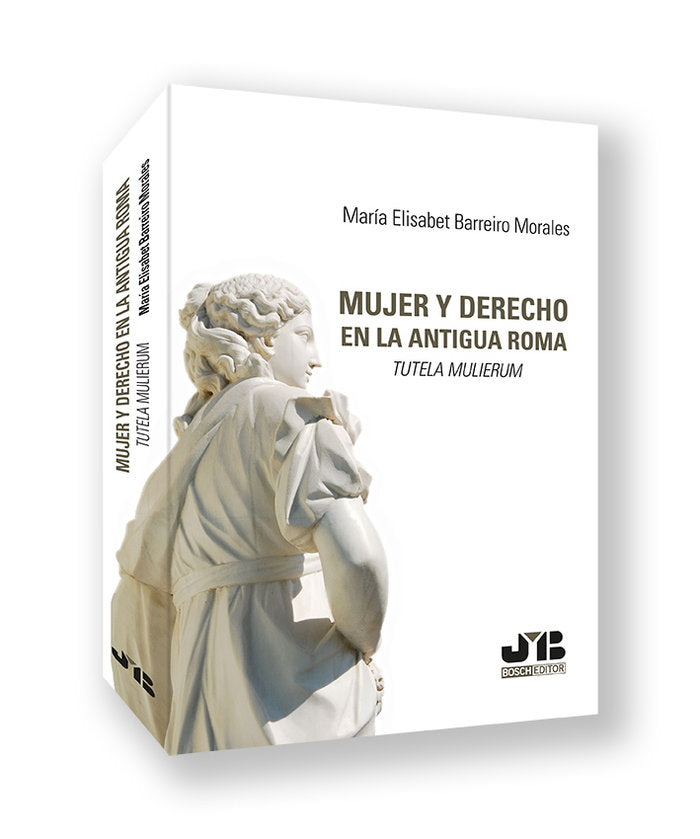

Description
Women and Law: Tutela Mulierum in Ancient Rome
Book Summary
This work offers a profound and rigorous analysis of the guardianship of women in ancient Rome, a legal institution that, when viewed from the modern mindset, is anachronistic and unacceptable. Through the exegesis of classical sources, the author unravels the archaic motivation behind this figure, revealing how, under the guise of protection, it concealed a mechanism of patriarchal control that limited female legal capacity. The book not only examines the restrictive origin of the guardianship, but also documents the fascinating evolution of Roman law, which gradually granted spaces of liberation to women, allowing them a prominence unthinkable in its beginnings. It is an essential study for understanding the roots of gender inequality in law and the capacity of the Roman legal system to adapt to social changes.
What is it about?
The book focuses on the institution of tutela mulierum (guardianship of women) in ancient Rome. The author begins with a clear premise: the contemporary rejection of any restriction on women's capacity, but without falling into anachronism. To this end, she conducts a detailed study of Roman legal and literary sources, with the goal of understanding the deep motivation that led to the creation of this figure in archaic law. The research reveals that, although it was presented as a protective mechanism, its true intention was to diminish the legal status of women within a patriarchal system. However, the value of the book lies in showing the evolution of the Roman ius, which, slowly but progressively, granted greater degrees of freedom and prominence to women, until they achieved a status unthinkable in the first centuries. The work concludes by highlighting the excellence of Roman law as a system that, despite its initial limitations, was able to regulate social coexistence and adapt to a new female role, without ever granting them absolute legal freedom.
Main Topics
- Historical-legal analysis of tutela mulierum as an institution of Roman law.
- Study of classical sources (legal, literary, and historical) to understand the origin and evolution of female guardianship.
- The relationship between law, patriarchy, and the limitation of women's legal capacity in ancient Rome.
- The evolution of the Roman ius and the progressive granting of spaces of liberation and autonomy for women.
- The contradiction between the stated protective function of guardianship and its real effect of control and subordination.
Who is it recommended for?
This book is aimed at law students and professionals, especially those interested in legal history, Roman law, and gender studies applied to the legal field. It will also be of great value to historians, classical philologists, and any reader with intellectual curiosity about understanding the historical roots of gender inequality and the evolution of legal systems in relation to the role of women in society.
What this book contributes
- A rigorous and updated analysis of tutela mulierum, based on the exegesis of primary sources.
- A critical perspective that dismantles the traditional view of guardianship as a simple protective measure, revealing its function of patriarchal control.
- A deep understanding of the evolution of Roman law and its capacity to adapt to social changes, albeit in a limited way.
- A solid foundation for reflecting on the origins of legal restrictions on women's capacity and their overcoming in contemporary law.
Technical Sheet
- Author: BARREIRO MORALES, MARIA ELISABET
- Publisher: J.M. BOSCH EDITOR
- Language: Spanish
- Subject: ROMAN LAW
- Collection: FONDO
- Binding: Paperback
- Edition date: November 2023
- Number of pages: 492
- Weight: 850 g
Editorial Assessment
We are dealing with an academic research work of the highest level, which addresses a complex topic of great historical and legal relevance with solvency and clarity. The author, a specialist in the subject, manages to build a bridge between Roman law and contemporary concerns about gender equality, without sacrificing philological and historical rigor. The book will be of great interest to specialists seeking an updated and critical study, as well as to those readers who wish to understand how the legal structures of the past have influenced the shaping of women's rights. It is, without a doubt, a valuable contribution to the editorial catalog on Roman law and gender studies.